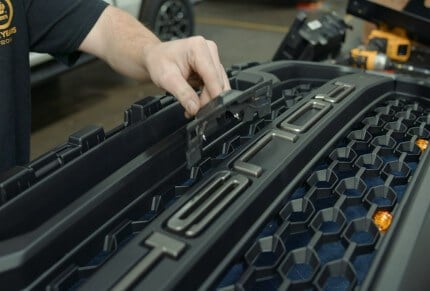
Large format 3D printing is transforming how automotive teams work, enabling faster prototyping, agile tooling, and on demand production. Stratasys additive solutions deliver the material performance, reliability, and scale that manufacturers like Toyota, GM, and Roush depend on.
Polymer 3D printing gives auto manufacturers the ability to accelerate idea implementation, avoid tooling bottlenecks, and sidestep supply chain disruptions. For engineers, it means faster design iteration and concept validation, fueling innovation. For production teams and plant managers, it enables more agile tooling, fewer delays, and more uptime.
This is made possible by the toolless nature of additive manufacturing, allowing prototypes, tooling, and production parts to be created faster and more efficiently than with traditional methods.
Explore Toyota's real-world additive manufacturing tooling applications across assembly, inspection, EOAT, paint, and low-volume production.
A 3D printed hemming tool was produced in three weeks in contrast to the 10-13 week timeframe needed for an aluminum tool, a lead time savings of over 70%.
Instead of injection molding, Roush engineers 3D printed the mounts with SAF™ technology using the H350™ printer. 3D printing the camera mount resulted in at least a 50% cycle time reduction compared to injection molding and a 35% cost reduction.
3D printing the tooling fixture allowed J.W. Speaker to reduce the tool production time by approximately 80%, from two days to 10 hours.
Explore Toyota's real-world additive manufacturing tooling applications across assembly, inspection, EOAT, paint, and low-volume production.
A 3D printed hemming tool was produced in three weeks in contrast to the 10-13 week timeframe needed for an aluminum tool, a lead time savings of over 70%.
Instead of injection molding, Roush engineers 3D printed the mounts with SAF™ technology using the H350™ printer. 3D printing the camera mount resulted in at least a 50% cycle time reduction compared to injection molding and a 35% cost reduction.
3D printing the tooling fixture allowed J.W. Speaker to reduce the tool production time by approximately 80%, from two days to 10 hours.
From faster prototyping, to better support tooling to economical customization and production, additive manufacuturing in the automotive industry offers time and cost efficiencies while getting products to market faster.
Validate ideas faster to arrive at the optimal design before investing in expensive production tooling.
Keep production running with tooling created and deployed in a fraction of the time of traditional tools.
3D printed production parts are the perfect solution for cost-effective customization and on-demand production.
Validate ideas faster to arrive at the optimal design before investing in expensive production tooling.
Keep production running with tooling created and deployed in a fraction of the time of traditional tools.
3D printed production parts are the perfect solution for cost-effective customization and on-demand production.
Stratasys 3D printers suited for automotive applications include PolyJet, FDM, and SAF printers. PolyJet is ideal for high-fidelity visual and functional prototyping, enabling rapid validation of form, fit, finish, color, texture, transparency, and snap-fit performance—critical for interior trim, lighting components, and design reviews. FDM technology platforms are highly appropriate for prototyping and production tooling applications. SAF powder bed technology offers higher-volume production capabilities and lower cost per part relative to competing powder-bed systems.
High-speed industrial 3D printer. Benchmark FDM reliability and quality, with up to twice the print speed of competitive platforms for increased throughput and lower cost per part.
The H350 utilizing SAF powder bed technology provides cost-effective part production at scale.
High-precision industrial 3D printer with exceptional surface finish, speed, repeatability, and material versatility. Matches injection molding precision, enabling short production runs and on-demand manufacturing.
Large capacity, high-performance materials, and proven dependability make the F900 the FDM workhorse.
Designed by engineers for engineers, it delivers exceptional speed and performance, producing injection mold-quality parts up to 50%* faster.
Multi-material industrial 3D printer. Print prototypes that look, feel, and function like the finished product, letting you simplify and speed up product development. High print resolution and incredible accuracy enable smooth surfaces, details like printed graphics, and complex geometries.
The Fortus 450mc delivers industrial-grade printing with a highly versatile range of materials.
A professional, industrial-grade printer compatible with carbon fiber and engineering-grade thermoplastics to produce functional prototypes, strong workholding fixtures, tooling, and parts in the office or classroom.
Office-friendly 3D printer with full color, tactile, multi-material, and functional capabilities for both industrial and mechanical design. Designed for consistent, stable performance, allowing you to iterate faster and make more accurate design decisions.
Affordable, office-friendly 3D printer. All the benefits of an engineering-grade printer without the hassle, thanks to a small footprint, low-maintenance design and silent, odor-free operation.
High-speed industrial 3D printer. Benchmark FDM reliability and quality, with up to twice the print speed of competitive platforms for increased throughput and lower cost per part.
The H350 utilizing SAF powder bed technology provides cost-effective part production at scale.
High-precision industrial 3D printer with exceptional surface finish, speed, repeatability, and material versatility. Matches injection molding precision, enabling short production runs and on-demand manufacturing.
Large capacity, high-performance materials, and proven dependability make the F900 the FDM workhorse.
Designed by engineers for engineers, it delivers exceptional speed and performance, producing injection mold-quality parts up to 50%* faster.
Multi-material industrial 3D printer. Print prototypes that look, feel, and function like the finished product, letting you simplify and speed up product development. High print resolution and incredible accuracy enable smooth surfaces, details like printed graphics, and complex geometries.
The Fortus 450mc delivers industrial-grade printing with a highly versatile range of materials.
A professional, industrial-grade printer compatible with carbon fiber and engineering-grade thermoplastics to produce functional prototypes, strong workholding fixtures, tooling, and parts in the office or classroom.
Office-friendly 3D printer with full color, tactile, multi-material, and functional capabilities for both industrial and mechanical design. Designed for consistent, stable performance, allowing you to iterate faster and make more accurate design decisions.
Affordable, office-friendly 3D printer. All the benefits of an engineering-grade printer without the hassle, thanks to a small footprint, low-maintenance design and silent, odor-free operation.

Stratasys 3D printing technologies offer diverse materials to address multiple automotive applications. These include PolyJet materials for high-fidelity visual and functional prototyping—such as rigid, flexible, transparent, and digital materials that enable realistic color, texture, transparency, and snap-fit validation—as well as engineering-grade and high-performance FDM thermoplastics for functional prototyping and tooling, and nylon polymers used with SAF powder-bed technology for higher-volume production and cost-efficient end-use parts.
Standard thermoplastics, carbon-fiber composites, and high-performance PEI polymers highlight the FDM material portfolio.
SAF technology powdered polymers provide the capability to 3D print with widely used industrial materials.
ToughONE™ material expands the capabilities of PolyJet™ technology, bridging the gap between visual appeal and functional performance.
Standard thermoplastics, carbon-fiber composites, and high-performance PEI polymers highlight the FDM material portfolio.
SAF technology powdered polymers provide the capability to 3D print with widely used industrial materials.
ToughONE™ material expands the capabilities of PolyJet™ technology, bridging the gap between visual appeal and functional performance.
3D printing allows automotive teams to move from CAD to physical parts in days, not weeks – speeding up design validation and enabling more iterations early in the development process.
Teams use it to create full-size design prototypes, assembly fixtures, and ergonomic jigs. It reduces reliance on external vendors, improves turnaround time, and allows for fast tool changes and customization.
Stratasys supports ABS, ASA, carbon fiber-reinforced nylon, ULTEM™, and elastomers. These materials offer the strength, thermal resistance, and repeatability needed for both shop-floor tooling and in-vehicle components.
Many parts can be printed and in-hand within a day or two. This makes it easy to prototype fast, avoid downtime, and respond quickly to late-stage design changes or supplier delays.
OEMs are embracing additive for EV part lightweighting, digital spares, short-run custom builds, and fast-response tooling. The shift toward agile manufacturing is making additive a core capability, not just a prototyping tool.
Share your part, material, or production challenge with our team. We’ll help recommend the right technology for your goals, whether you’re replacing legacy tooling or scaling printed parts for real production use.