

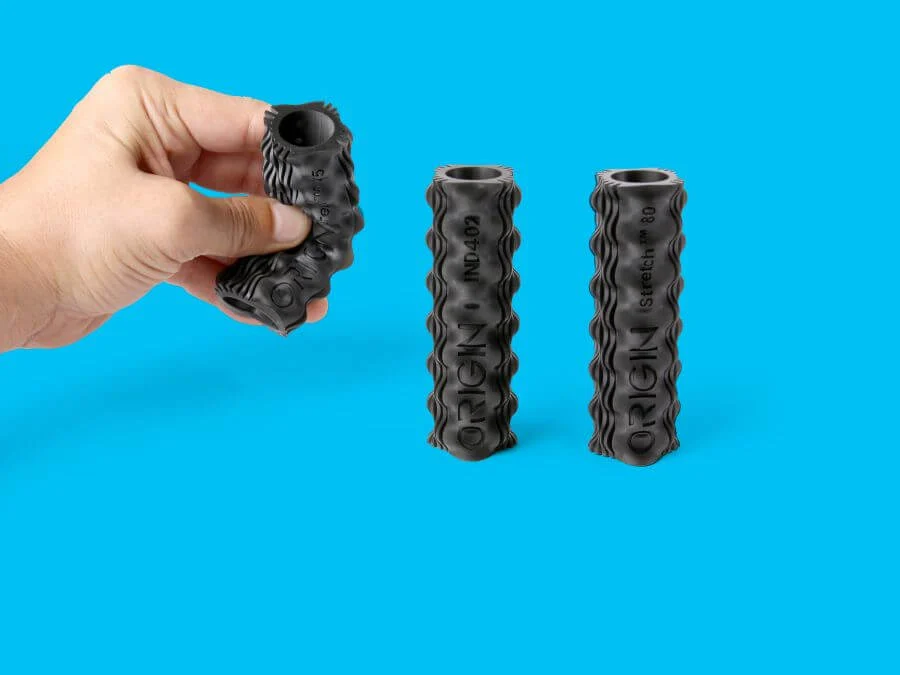


At a Glance:
Digital Light Processing (DLP) 3D printing uses projected light to cure photopolymer resin, producing parts with excellent accuracy, smooth surface finish, and functional material properties. Combining speed, reliability, and broad material compatibility, DLP bridges prototyping and production, delivering isotropic, high-performance parts for automotive, aerospace, industrial, medical, and consumer applications. Stratasys’ P3™ programmable photopolymerization advances DLP with closed-loop process control and a patented pneumatic separation system for exceptional precision, repeatability, and surface quality.
DLP (Digital Light Processing) printing is a resin-based 3D printing technology that uses a digital projector screen to cure liquid photopolymer. By flashing an entire layer image simultaneously using a Digital Micromirror Device (DMD), it achieves significantly faster print speeds and higher accuracy than point-to-point laser systems, making it a viable alternative to injection molding.
This makes DLP well suited for low volume production parts.
After each layer cures, the build platform lifts to let fresh resin flow underneath for the next cross-section. The full layer projection method is what gives DLP its speed advantage over other resin technologies.
The DMD itself, developed by Texas Instruments in 1987, contains thousands of microscopic mirrors that can be controlled individually. Each mirror reflects light either toward the build area or away to a beam dump, and rapid switching between these positions controls the effective brightness of each pixel. Digital Projection used the technology to build the first DLP projector ten years later.
When it comes to DLP printers, the actual DLP projector is just one component (albeit a critical one) in a complex 3D printing machine. DLP 3D printers have four major components:
Here’s how they interact with each other to print a 3D part:
1. The vat contains a photopolymer resin, meaning a type of plastic that hardens when exposed to light.
2. A flexible membrane at the bottom of the vat (under the build platform) expands downwards, and a thin layer of resin flows in. 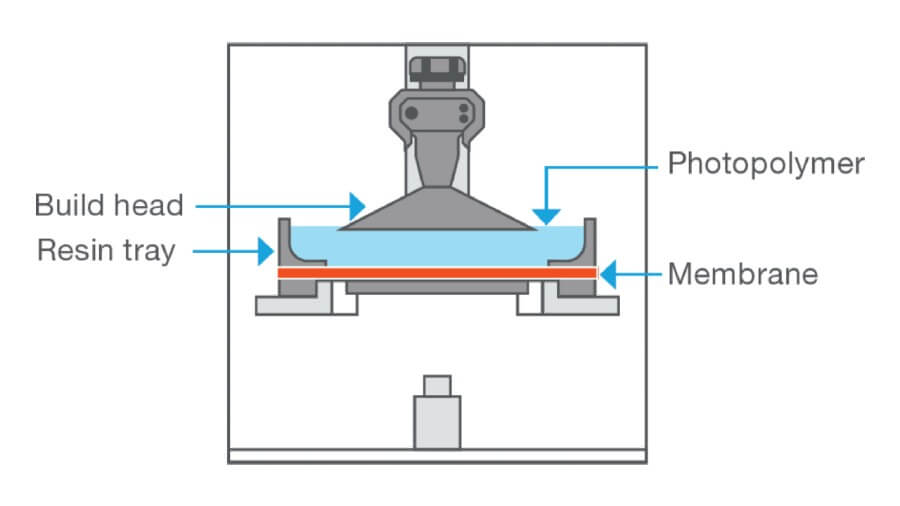
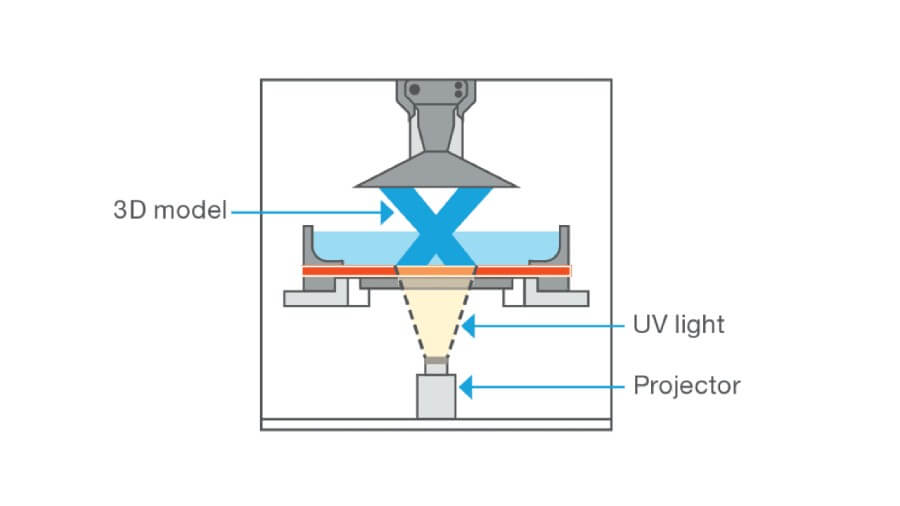
3. The DLP projector hardens an entire slice of the 3D printed part at once, by projecting an image of that slice onto the surface of the resin in the vat.
4. The membrane contracts upwards to connect to the build platform and a thin layer of resin between the membrane and the build platform is cured.
5. The build platform is raised (very slightly, this is the Z-axis resolution) to allow more resin to flow underneath.
6. Steps 2-5 are repeated for each slice until the part is complete.
Additive manufacturing (AM) can be categorized in several ways, but perhaps the simplest is to start with the material used. To grossly oversimplify, these are the material categories:
All plastic types undergo a change from a more fluid or moldable state to their “end-result” state. The primary difference between thermoplastics and thermosets is the reversibility of this change. Thermoplastics undergo a fully bidirectional process when they harden or set into a “permanent” state.
This process can be reversed to return the original raw material. By contrast, thermosets – as the name would suggest – are set in place. Once the plastic is cured, it cannot be returned to its original state.
Another way to look at it is what happens when heat is applied to the set plastic:
Any given additive manufacturing technology (usually) works with only one type of material category.
ISO recognizes seven major groups of AM technologies:
|
ISO Term |
Variations |
Material Category Used |
|
Binder jetting |
|
Metal (and other non-plastic materials) |
|
Directed energy deposition |
LDW, EBAM, LENS |
Metal |
|
Material extrusion |
FDM |
Thermoplastics |
|
Material jetting |
PolyJet |
Thermoset |
|
Powder bed fusion |
SAF |
Thermoplastics |
|
Sheet lamination |
|
Metal |
|
Vat photopolymerization |
SLA, DLP, LCD |
Thermoset |
It is clear from this overview that DLP is most closely related to other forms of vat photopolymerization. That said, it is useful to compare all forms of polymer 3D printing to see when it is best to use DLP, and when other methods would be preferred.
Let’s take a closer look at vat photopolymerization and its various forms.
SLA shares many features with DLP:
The main differences are related to the type of UV source and direction of printing:
LCD is even more closely related to DLP 3D printing. In this case, both technologies use a projected image to cure each layer at once, and both technologies expose the photopolymer resin from the bottom. Here are the differences between the two:
Whereas DLP uses a projector with DMD (microscopic mirrors) to reflect UV light onto the photopolymer resin, LCD uses an array of UV LEDs that are partially masked by an LCD screen to determine which points should be cured. For this reason, LCD is sometimes called masked SLA (mSLA) 3D printing. DLP is a more mature AM technology and is based on components that are more reliable and long-lasting, if more expensive. It also provides higher irradiance than LCD, which means it can manage a wider variety of materials. LCD is susceptible to pixel bleeding and uneven degradation of the light source, which is why it’s usually seen more in hobbyist 3D printers, as they can sacrifice some level of repeatability and precision in favor of a lower cost.
At the risk of overgeneralization, let’s sum up the core differences between DLP, LCD, and SLA printers. Most of the values in the table below vary significantly based on price point, material, and other factors. However, it should provide a general idea of strengths, weaknesses, and when to use each of these 3D printing resin-based technologies:
|
SLA |
LCD |
DLP |
|
|
Light source wavelength |
355 nm |
405 nm |
385 nm |
|
High performance materials |
Broad Range |
Limited |
Broad range |
|
Print speed |
Medium/fast |
Very fast |
Fast |
|
Build size |
Small to Large |
Small to medium |
Small |
|
Price (hardware) |
Medium to high |
Low |
Medium to high |
|
Accuracy and Precision |
Excellent |
Medium |
Excellent |
|
Typical applications |
|
|
|
DLP 3D printing offers significant industrial advantages, including extreme precision, high-speed production, and reduced maintenance costs. By utilizing a Digital Micromirror Device (DMD), it provides consistent resolution and sharp details, making it a reliable alternative to injection molding for high-performance functional parts.
DLP utilizes individual pixel control to create parts with smooth surface finishes and intricate details. Because the light source is stationary, it eliminates the vibration or inaccuracies often found in laser-based systems.
The DLP light engine typically has a longer lifespan than LCD screens. These projectors are built for industrial reliability, maintaining consistent UV output over thousands of hours of operation.
Because the projector flashes an entire layer simultaneously, the print time is determined only by the height of the part, not the quantity or complexity of items on the build plate.
With fewer moving parts than FDM or SLA systems, DLP printers experience less mechanical wear. The closed light engine design also protects sensitive optics from dust and resin contamination.
DLP can 3D print using materials with a variety of properties. Its 385 nm UV light source is well suited to cure a wide range of resin materials. The common denominator of all compatible materials is that they must be a photopolymer. (Remember the whole process of DLP printing is based on curing resin with light.)
DLP photopolymers can be grouped into the following functional categories:
High temperature-resistant materials tend to be more brittle, whereas more elastic or tough materials tend to have lower temperature resistance. This should be kept in mind when determining the material best suited for your application.
These materials are the jack-of-all-trades when it comes to 3D printing with DLP. They have the following benefits:
Tough materials can withstand impact or repetitive motions. While their elasticity can vary, they generally share high impact strength. Tough DLP materials can be categorized by the type of thermoplastic they mimic, e.g.:
These materials mimic rubber in various forms, for application such as:
Elastomeric photopolymers are quantified by:
Generally speaking, materials with lower Shore values can stretch farther (longer elongation at break). Harder elastomers can be used for form, fit, and functional prototypes, while softer elastomers might be more commonly used in seals and gaskets.
These are DLP materials that can withstand sustained exposure to heat, typically quantified with a measurement of its heat deflection temperature (HDT). They may also be certified to handle flame, smoke, and toxicity (FST). Heat-resistant materials also tend to resist moisture well, leading to better long-term dimensional stability. Note that high temperature materials usually are more brittle than other categories of materials. Applications involving repeated strain, impact, or risk of dropping should avoid using these materials.
High accuracy and smooth surface finish make DLP suitable for printing medical devices, using special medical-grade materials that have been certified according to the relevant regulatory requirements and standards.
The above general categories can be used for many applications. For use cases that require specialized properties (e.g., ESD protection, flame retardancy), other special purpose materials can be used. These 3D materials can be delineated by the traditional thermoplastic material they replace, for example:
Design for additive manufacturing (DfAM) is the idea that 3D printing doesn’t only start with the actual printer. It starts with the design of a part. Current design is done with the limitations of traditional production methods in mind. As we’re dealing with a fundamentally different method of production, part design shouldn’t be limited by irrelevant restrictions. DfAM lets you harness the full potential of additive manufacturing.
When using additive manufacturing for production parts, designing for the technology is critical in order to tap into the true benefits of AM. Good DfAM can help you improve quality, functionality, and throughput, leading to lower overall costs and a greater number of viable applications for additive production. Furthermore, if you design for additive, you can often consolidate parts into a single, integrated part, reducing assembly labor and the quality challenges often linked to precision manual assembly processes.
Step 1 – Consider the part and application:
Step 2 – Choose an AM material:
Step 3 – Consider print part orientation:

Part orientation can also affect surface quality:
Step 4 – Consider support requirements:
Step 5 - Cleaning and post-curing:
For example, the venturi valve shown below (as a cross section) is fully self-supporting, as long as it is printed in the orientation shown at left (three ports facing downwards, one upwards). If it were printed in the other orientation, the central internal fluid outlet, (marked in red) would need support.
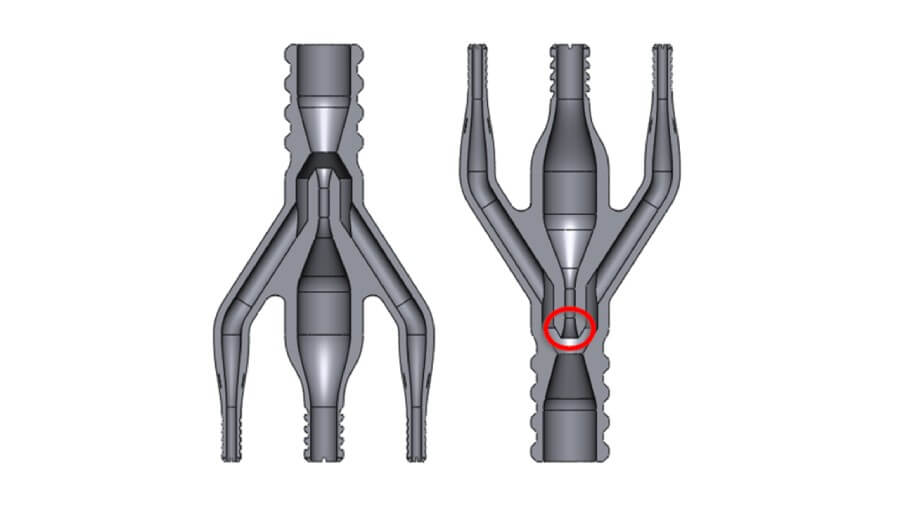
However, to print this part in volume, nesting density plays a major role. If all parts had the same orientation, fewer could fit in a single print, reducing throughput. Therefore, there was a need to use both orientations, requiring support for one of them.
Using support material in DLP is not a problem as such, but in this case, it did pose a challenge. The logical way to add support would be like this (green lines):
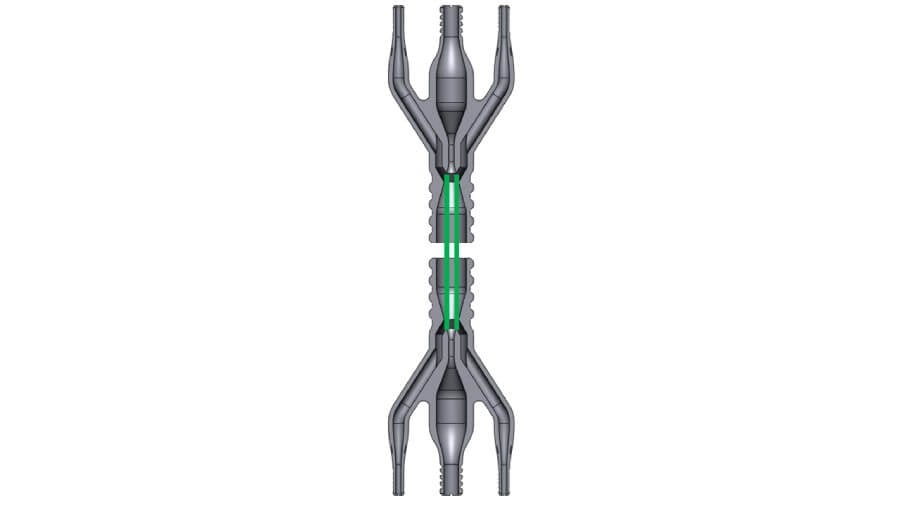
However, placing support structures inside a closed tube would make them almost impossible to cleanly remove. Instead, by slightly altering the design, the venturi valve is fully self-supporting in both orientations:
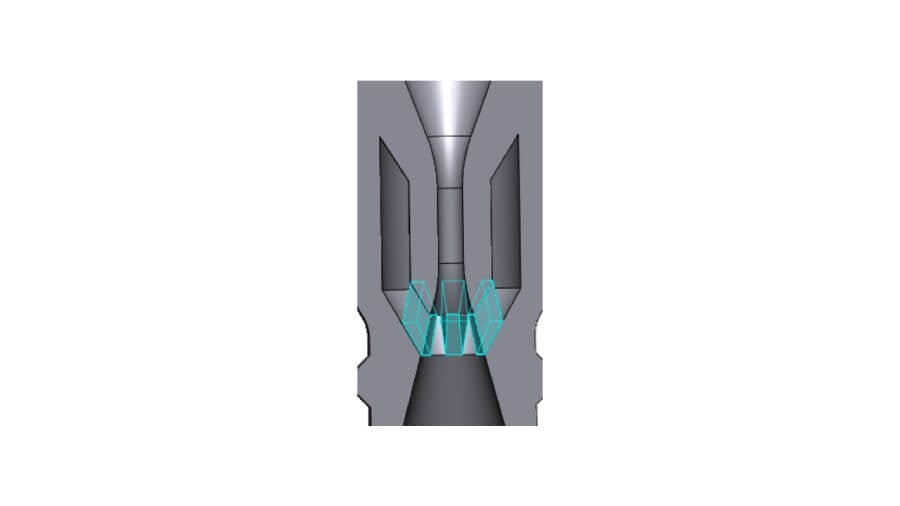
This solution adds self-supporting buttresses (highlighted blue) connecting the side wall and the central internal fluid outlet to support the unsupported port while still allowing unimpeded airflow.
DLP 3D printing technology is already used to print high quality, repeatable, fully functional parts. And it’s poised to get even better:
This method has several advantages:
DLP is used in a variety of additive manufacturing applications. The common denominator is any case which requires both high part accuracy and precision, or fine surface finish, as well as a high-performance material (such as tough, rigid, elastic, or high temperature resistant materials). Here are some examples of use cases where DLP 3D printing excels:
TryTec wanted to get into the medical device business. After meeting with some medical professionals, they understood the need clearly – find a way to clean endoscopic devices, fast. They had a concept, but the geometry was very tricky. It didn’t seem suitable for injection molding.
DLP 3D printing combined two integral attributes needed for this product to get off the ground:


