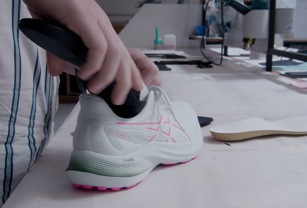
Learn how the decision of Tim Ganley, founder & managing director of GO Orthotics to adopt 3D printing resulted in improved patient outcomes. Register here
Explore the future of 3D printing with our webinar. Discover innovations, enhance efficiency, and stay ahead in your industry with Stratasys
Learn how selective absorption fusion (SAF) technology & 3D printing are redefining the landscape of custom insoles production. Get your solution guide now
Learn more about the resilience of Stratasys® SAF™ PA11 and PA12 materials against automotive chemicals. This white paper reveals the results of rigorous testing, offering insights into their performance and stability under various challenging conditions.
Discover the groundbreaking insights in the ARC Stratasys White Paper, a comprehensive guide to reshaping industrial manufacturing through additive technologies.
Watch how GO Orthotics stays ahead with additive manufacturing. Explore the impact of the H350TM SAF 3D printer and High Yield PA11 in revolutionizing orthotics production.
Stratasys AM Certification Program help to equip students with the skills necessary to thrive in today's job market and future-proof their careers. Join us
Lisez notre nouvelle étude de cas pour découvrir comment 3D Composites pénètre de nouveaux marchés grâce à la technologie SAF.
Tired of dealing with the hassle of managing multiple 3D printers across different departments? Join us and learn how to maximize efficiency through collaboration
Unleash the full potential of additive manufacturing in education & research: Join our webinar & explore the cutting-edge capabilities of 3D printing materials!